


By Uchenna Ezeadigwe
Awka
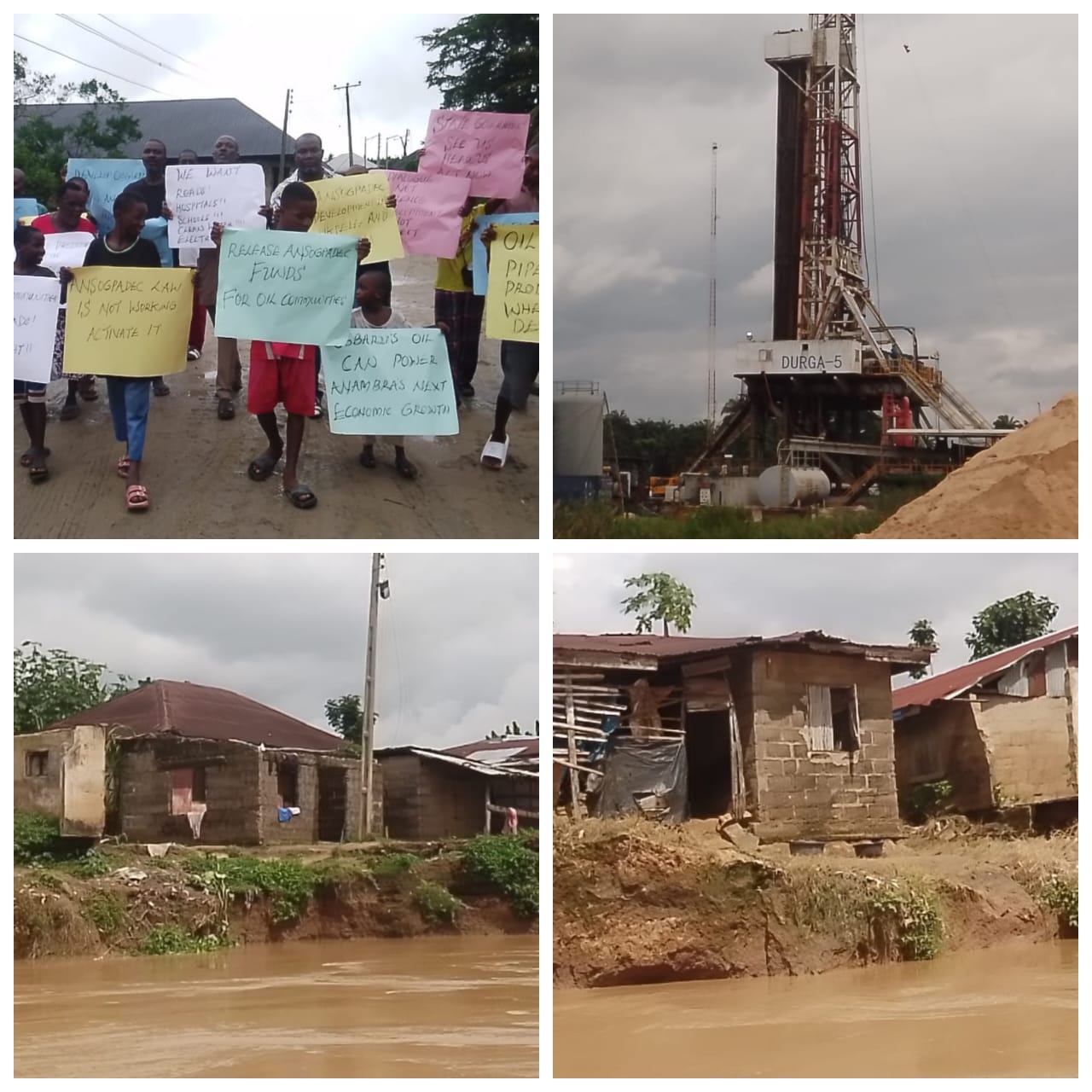
The road from Atani to Ogwuaniocha and Ogwuikpele does not look like the road into oil-producing communities.
From Umunankwo through Mputu towards Ogwuaniocha, the journey becomes increasingly difficult, with motorcycles often the most practical means of transport. Access to neighbouring Ogwuikpele is even worse. During the rainy season, the road from Ossomala is submerged, leaving residents dependent on boats to cross the River Niger.
For communities sitting above crude oil reserves, the contradiction is difficult to ignore.
Oil exploration has brought industrial activity and security concerns, residents say, but little of the development they expected: no reliable roads, electricity, potable water, functional healthcare or adequate schools.
That frustration now lies at the heart of demands from Ogwuaniocha and Ogwuikpele in Ogbaru Local Government Area of Anambra State for government and oil operator Sterling Oil Exploration and Energy Production Company Limited (SEEPCO) to deliver on their obligations.
At the centre of the communities’ demands is the Anambra State Oil and Gas Producing Areas Development Commission (ANSOPADEC), which indigenes want the state government to make fully operational.
Oil Wealth, Little Development
The traditional ruler of Ogwuikpele Community, Anambra State, Odua Ukwu Ogwuikpele, Anagboso Anselm Bernad Ignatius Okaka, has decried the poor living conditions in the oil-producing community, calling on the Federal and Anambra State governments to urgently address the infrastructure and environmental challenges confronting his people.
Speaking during an interview, the traditional ruler said residents had initially welcomed the arrival of oil exploration company SEEPCO with the expectation that its operations would bring development to the community.
“When the oil exploration company SEEPCO came into our community, we thought good things had come to stay. We never knew we were going to face the worst of it all. The life we were living before was far better than what we are experiencing today.”
He expressed concern over what he described as deaths and environmental degradation associated with oil exploration activities in the area.
“The oil they are drilling has caused deaths among our people. The death toll this month has increased to seven within August. Here, they get the oil, but we have not seen any sign of the 13 per cent derivation meant for us. We are living as if we are inside holes.”
The monarch appealed to the Federal and State Governments to provide basic infrastructure, including roads, potable water, electricity, healthcare facilities and schools.
“What I am saying is that the Federal Government should remember us. We do not have good roads, pipe-borne water, electricity, a hospital or a good school. The school our children are managing is owned by the Church. We are living in darkness.”
He said the situation had become painful for the community and appealed to the authorities to intervene.
“We plead with the Federal and State Governments to come to our aid. If there is anywhere we have offended, let us know so that we can apologise. We voted for them, and we expect them to use our resources for the development of our communities rather than for frivolities.”
The traditional ruler added that the community’s youths were increasingly frustrated by the situation, but elders had continued to encourage them to pursue dialogue.
“Our youths are eager to quench the fire, but we the elders are holding them back. All we plead is that the government remembers us and provides these basic amenities.”
In an emotional outburst, Odua Ukwu Ogwuikpele also called for accountability in the management of funds intended for development projects in the community.
Community Leadership Accuses Oil Company of Neglect
The President-General of Ogwuikpele Community, Hon. Esumai Patrick Chukwudi, also criticised the operations of SEEPCO, alleging that the company had failed to deliver meaningful development to the community despite years of oil exploration.
According to him, the community had little to show for the company’s presence.
“They have defrauded the state government, local government and the community. There is nothing to showcase in Ogwuikpele. There is no metering system to determine the actual volume of oil leaving our community.”
He alleged that crude oil was being transported from Ogwuikpele to Delta State through a horizontal directional drilling (HDD) system and trucking operations without adequate mechanisms, in the community’s view, to monitor the volume being transported.
“They laid a pipe from Ogwuikpele down to Delta State. There is no electricity, no jobs for the youths and no water, not even a school. Yet they are using gas to power their office.”
Chukwudi further alleged that SEEPCO had no visible corporate presence in Anambra State and called on Governor Chukwuma Soludo to facilitate a dialogue between the company and the host community.
“We do not know who is behind them or what has made them humiliate and reject Ogwuikpele. We are calling on the governor, Professor Chukwuma Soludo, since he has stepped into this matter, to use his good office to help us.”
He said the community had remained peaceful despite its grievances and had consistently sought dialogue with the company and government.
“We are not asking for too much. There is gas flaring; why not convert it to electricity? Our people are not volatile. We have been dialoguing.”
The President-General of Ogwuaniocha, Hon. Vitalis Ekwuanua, said residents had seen little meaningful development since SEEPCO began operations in the area in 2016.
He said oil exploration had affected agriculture, aquatic life and the environment, while the community continued to lack basic infrastructure.
“We have oil in our communities, yet we are suffering the effects of oil exploration. Our aquatic life, agricultural production and environment have all been affected.”
Ekwuanua urged Governor Chukwuma Charles Soludo to fully operationalise ANSOPADEC by constituting its board and other necessary structures.
He also argued that host communities should have meaningful representation in the commission, including consideration for the chairmanship.
“We are law-abiding citizens, and that is why we are taking this matter peacefully and asking the state government to come to our aid,” he said.
The same frustration is evident in Ogwuikpele.
Its traditional ruler, Ogwuikpele, Anagboso Anselm Bernad Ignatius Akaka, Odua Ukwu, said residents initially welcomed SEEPCO’s arrival with the expectation that oil production would bring development.
“When the oil exploration company SEEPCO came into our community, we thought good things had come to stay. We never knew we were going to face the worst of it all.”
He said the community still lacked good roads, electricity, potable water, hospitals and adequate schools, despite oil being extracted from the area.
Where Crude Meets Broken Roads
For indigenes, the infrastructure deficit is most visible in transportation.
In Ogwuaniocha, farmers struggle to move produce to the market. Poor roads increase transport costs and reduce the value of agricultural goods.
In Ogwuikpele, the situation is more severe. Ossomala is the last accessible land point, after which they often have to travel by boat. During the rainy season, when the road is submerged, the dependence on waterways becomes almost total.
The Women Leader of Ogwuikpele, Mrs. Gladys Chukwudobi Nzeani, said the situation is particularly difficult for pregnant women and people requiring medical attention.
“When a woman is pregnant and wants to deliver, we find it difficult to transport her to neighbouring communities because there is no road, no good hospital and no electricity.”
She said a return boat trip between Ogwuikpele and Ossomala could cost about N10,000, further increasing the burden on residents.
Erosion has also damaged parts of the community market, she said, while the health centre lacks adequate equipment and drugs.
In Ogwuaniocha, Women President-General Lady Appolonia Ezenwa said the poor roads had left farmers, particularly women, struggling to get their produce to market.
She accused SEEPCO of failing to make a meaningful contribution to the host community since beginning operations and called for greater government oversight.
The Price of Isolation
Transportation problems have also pushed up the cost of living in Ogwuikpele.
Indigenes stated that goods transported by boat cost significantly more than in nearby urban centres. For example “A bag of sachet water, for example, was said to sell for about N1,000, while bread reportedly costs around N1,000 compared with roughly N500 elsewhere.”
The geography of Ogbaru compounds the problem. Farming and fishing remain central to the local economy, but waterways that sustain livelihoods also make access to healthcare, education and markets more difficult.
For pregnant women, serious medical complications may require travelling outside the community, sometimes towards Ihiala, because adequate healthcare is unavailable locally.
Mrs. Victoria Onwuahammadu, another community women leader, described the situation as unbearable.
“Life is unbearable for us in this community. I can’t remember the last time I saw electricity or received proper health and medical attention.”
“We suffer mostly cholera, malaria and ulcer, like me, I am a Ulcer patient. You find it difficult to treat yourself, we are pleading with the state government to come and assist us with medicals.”
Children Paying the Price
The condition of local schools has become another major concern.
Some of the indigene who spoke to our correspondent described the Ogwuaniocha and Ogwuikpele Community Primary Schools as being in poor condition and said the Community Secondary Schools faces shortages of teachers and basic facilities.
Chief Innocent Awogu, a former youth leader, said education should be treated as an urgent priority.
Mr. Augustine Ojigbani, another resident, said Ogwuaniocha produces food for the state but lacks the infrastructure required to move agricultural produce to the market. He also called for the deployment of more teachers ahead of the new school year.
In Ogwuikpele, the traditional ruler said the community lacked a good school, with children depending largely on a Church-owned institution.
The President-General of Ogwuikpele, Hon. Esumai Patrick Chukwudi, alleged that SEEPCO had failed to fulfil some commitments made to the community.
“No single person from the community has been employed. They promised us scholarships four years ago. They gave about 20 persons school scholarships in the first year, and that was all.”
The National Youth Secretary, Mr. Titus Uchenna Nwosu, similarly alleged that a Memorandum of Understanding between SEEPCO and the community had expired without renewal and that scholarships promised for four years were provided for only one year.
SEEPCO’s performance and compliance with such agreements are matters that require documentary verification.
Oil, Environment and Conflict
The communities’ concerns extend beyond infrastructure.
Indigenes have raised allegations of oil spills, environmental degradation, damage to aquatic life and gas flaring. These claims require independent environmental evidence, but they have become an important part of the communities’ demand for greater transparency.
In Ogwuikpele, the traditional ruler linked oil exploration to what he described as deaths in the community. In Ogwuaniocha, Ekwuanua said residents had observed damage to agriculture and aquatic life.
The history of oil production in Ogwuaniocha has also been accompanied by disputes over leadership, land and compensation.
The community suffered a major crisis following the abduction of its traditional ruler, Igwe Oliver Nnaji, in 2021 and the subsequent burning of his palace. Several people were killed during the wider conflict.
Community leaders have alleged that oil-related interests contributed to divisions within the community. Such claims require evidence and should not be treated as an established fact.
Where Does the Oil Go?
The journey of Anambra’s crude beyond the communities raises another set of questions.
In July 2025, SEEPCO told the Revenue Mobilisation Allocation and Fiscal Commission (RMAFC) that its operations under OML 143 connect Anambra field locations to existing infrastructure in Delta State and that produced oil and gas are monitored through established metering and evacuation systems.
RMAFC’s engagement followed complaints concerning host-community obligations, environmental compliance, gas flaring, compensation and the evacuation of petroleum from Anambra towards Delta State.
SEEPCO said it valued the dialogue and would provide relevant technical and environmental records.
Community leaders, however, have continued to question the transparency of production and evacuation.
Hon Esumai alleged that the community lacked sufficient mechanisms to independently determine the volume of crude being evacuated and called for greater transparency.
These are allegations that require verification through production records, metering data, regulatory documents, environmental reports and host-community agreements.
The key questions are straightforward: How much oil is produced? How much revenue is generated? What obligations does the operator have to the host communities? What has been paid or delivered? And who monitors compliance?
Host-Community Benefits
The Petroleum Industry Act provides a framework for Host Communities Development Trusts intended to support development in qualifying host communities.
In 2024, the Anambra State House of Assembly reportedly summoned SEEPCO representatives over its operations in Ogwuaniocha and Ogwuikpele, including questions around compliance with the Petroleum Industry Act and corporate social responsibility obligations.
RMAFC subsequently engaged SEEPCO and community representatives in 2025.
The communities say these interventions have yet to translate into visible development.
Their concerns are therefore not limited to whether money exists. They want to know how much is available, who controls it, what projects are approved and how those projects are monitored.
Transparency, they argue, is essential to preventing suspicion and conflict.
ANSOPADEC: From Law to Action
The latest development is the operationalisation of ANSOPADEC by the Anambra State Government in August 2026.
The commission is expected to strengthen development and governance in the state’s oil-producing communities.
For Ogwuaniocha indigene Mr. Izuka Udoka, however, operationalisation must go beyond an announcement.
He recalled that the Anambra State House of Assembly passed the enabling law in 2024 and that Governor Soludo assented to it on June 12, 2025.
“We plead with him to operationalise the law. It is not working because the board is not in place. We want him to put the necessary structures into place.”
Udoka said the framework was intended to channel a portion of the state’s oil derivation resources towards addressing developmental and ecological challenges in oil-producing communities.
He also called for dialogue between SEEPCO and Ogwuaniocha and Ogwuikpele. He urged the government to consider host-community representation in the commission.
In Ogwuaniocha, Youth President-General Engr. Uchenna Onyedi made a similar appeal for adequate representation of the community on the ANSOPADEC board.
“The communities now want to see how the commission will operate in practice: how funds will be managed, how projects will be selected, whether contracts will be transparent and whether communities will have a meaningful role in determining development priorities.”
What Is the Oil Worth to the People?
The demands coming from Ogwuaniocha and Ogwuikpele are remarkably basic.
They want roads that can be used throughout the year. They want functioning schools and enough teachers. They want healthcare facilities capable of handling emergencies. They want potable water and electricity. They want environmental protection, employment opportunities and transparent management of funds meant for their development.
They also want a voice in institutions created to represent them.
None of these demands suggests that oil should solve every problem. Roads, schools, healthcare, water and electricity remain responsibilities shared across government institutions. Oil companies also have specific legal and contractual obligations.
The central issue is accountability.
The communities want the government and SEEPCO to put the relevant records on the table: production figures, host-community agreements, environmental assessments, development plans, payments, compensation, regulatory reports and evidence of projects delivered.
Without such transparency, the argument will remain trapped between competing narratives: the company’s claims of compliance and engagement, and the communities’ claims of extraction without development.
The truth may contain elements of both. That is precisely why the records matter.
The Wealth Beneath Their Feet
Anambra’s oil industry is still young enough for the state to learn from the failures of older oil-producing regions.
It can build a system in which communities understand what they are entitled to, environmental information is accessible, development funds are transparently managed and projects are independently monitored.
For Ogwuaniocha and Ogwuikpele, however, the measure of government will not be another announcement.
It will be the road indigenes can finally travel, the school where children actually learn, the health centre where women can safely give birth, the water families can drink and the electricity they can rely on.
The communities do not want to be known simply as places where crude oil comes from.
They want to be places where children go to school, farmers reach markets, families access healthcare and young people can build futures.
The oil beneath their feet has already put Ogbaru on Anambra’s economic map.
The challenge now is ensuring that the people above that oil are not left behind.
*THE WAY FORWARD*
ANSOPADEC is central to the solution. The Anambra State Oil and Gas Producing Areas Development Commission was established by law, with the aim of directing resources toward development and ecological challenges in oil-producing communities.
However, the report stresses that creating a law is not enough, the commission must be properly constituted, funded, transparent and effective.
Operationalisation in August 2026 is a significant step, but not the end of the problem.
Communities now want answers about who will sit on the board, how funds will be managed, how projects will be selected, and how performance will be monitored.
Community representation is a major concern. Ogwuaniocha, Ogwuikpele and the Ogbaru Oil and Gas Technical Committee (OOGTC) are demanding meaningful representation in ANSOPADEC, including consideration of community indigenes for leadership positions.
The Ogbaru Oil and Gas Technical Committee (OOGTC) Chairman, Engr Anthony Egwuatu disclosed that the two communities are only legitimately demanding that both SEEPCO fulfil its commitments and government provide public services and institutional support.
According to Engr Egwuatu OOGTC represents a broader collective political voice. Its push for stronger community participation reflects a growing desire among oil-producing communities to have a direct say in institutions and decisions affecting their resources and
development.
Bottom line
Operationalisation of ANSOPADEC should mark the beginning of accountability, not the conclusion of the process.
The communities are asking for basic services, environmental protection, fulfilment of agreements and meaningful representation.
Subcommittee Chairman ANSOPAEDEC, Hon Chief Tony Okwesa said the real measure of progress in these two communities will therefore be tangible development and transparent records not government promises or institutional announcements.
Meanwhile, all efforts made to reach relevant state government authorities for reaction proved abortive as at the time of filing this report.