

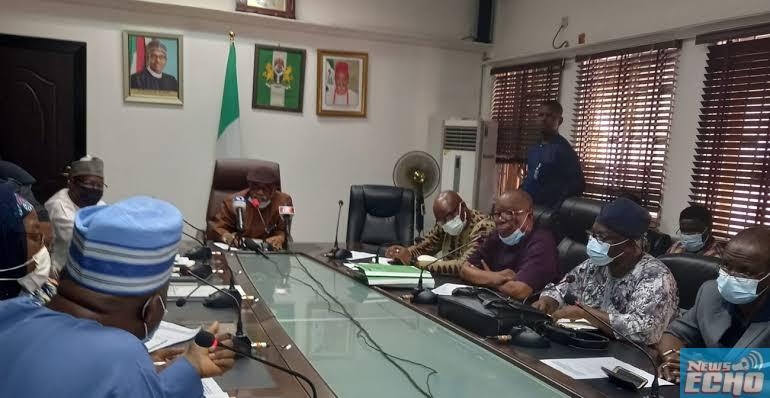

The federal government of Nigeria and the university lectures under its umbrella body, Academic Staff Union of Universities (ASUU) have been at war over the inability of the former to implement the 2009 renegotiated agreements which caused the continued shutdown of public universities since February 14, has been rolled over and is now in its sixth month.
While ASUU said it is awaiting the government to sign the renegotiated agreements, the government said it has no collective bargaining agreement with the union.
In a statement, the minister of labour and employment, Dr. Chris Ngige, said relevant ministries, departments and agencies (MDAs) were absent during the negotiation with Prof. Nimi Brigs’ committee set up by the ministry of education to renegotiate the 2009 agreement.
The 2009 agreement contains the conditions of service which ASUU demands its improvement.
The statement, signed by Olajide Oshundun, the head, press and public relations at the labour ministry, said ASUU had insisted that these relevant advisory MDAs recuse themselves from the sitting of the Briggs-led committee, accusing them of non-cooperation.
The MDAs, according to Mr Ngige, include the ministries of finance, education, labour and employment; Budget Office of the Federation, National Salaries, Income and Wages Commission, and Office of the Head of Civil Service of the Federation.
He said: “All alone with the Prof Briggs Committee, ASUU started fixing their salaries and allowances to the exclusion of the statutory government ministries and agencies that manage the entire annual finances of government, budget and fiscal policies, and the office of the head of civil service that is in charge of ensuring that public service rules and regulations are not undermined in any condition of service offered to public officers in the universities.”
Ngige added that the chief of staff to the president, Ibrahim Gambari, and the labour ministry set up an Inter-Ministerial/Agency sub-committee, comprising the affected MDAs under the Minister of State, Budget and National Planning “to quickly look into Prof. Briggs Committee report in June.”
He said the committee found that the proposal will lead to between 109 and 185 per cent increase in the university wage structure.
The minister further said; “The Federal Government will incur an additional N560 billion as salaries alone, on top of the present N412b, less all other allowances such as Earned Academic Allowances and fringe benefits, Teaching Allowance, field trip, responsibility and post-graduate supervision allowances, hazard allowances, which were to gulp another N170 billion.
“In all, the sum of N1.12 Trillion will be needed to pay the salaries and allowances of university lecturers and other staff in the university system. At present, the wage bill of the university staff and their colleagues in teaching health systems gulp nearly 50 per cent of the total federal government staff personnel cost/wages”.
He, however, noted that the Presidential Committee on Salaries and Wages has finished the review of the Prof Nimi Briggs proposal and will shortly submit it to the president.
In response to the statement, the ASUU president insisted that the agreements were a collective bargain.
He also accused, the Labour Minister, Chris Ngige of sabotaging reconciliation efforts by his comments.
“It’s collective bargaining and the position we have accepted, the money we have accepted, is an offer by the government. We have documentation.
Whatever was proposed is not from ASUU. We have our proposal but what was accepted by both sides –the Nimi Briggs committee representing the federal government and ASUU–, is the proposal by the Nimi Briggs committee,” Mr Osodeke said.
He added that “the minister who is supposed to be a conciliator is the one trying to destroy the process by instructing the ministry of finance to stop the lecturers’ salaries, among other things.”
On the said increase to be incurred by the government, Mr Osodeke said it is a better spending than the N4 trillion used by the government for subsidising petrol.
He said: “If Nigeria needed just 1.3 trillion naira to ensure that Nigerian universities compete with any university in the world; to ensure we now have foreign students coming to Nigerian universities, to ensure that the universities is such a way that you have e foreign lecturers coming into the system, which one is more important (between this) and spending N4 trillion to subsidise fuel”.
Commenting on the choice of payment platform by ASUU and other striking university-based unions, the labour ministry said fresh tests have been concluded on ASUU’s UTAS and the University Peculiar Payroll Payment System (U3PS) developed by the Senior Staff Association of Nigerian Universities (SSANU) and the Non-Academic Staff Union of Universities and other Associated Institutions (NASU). He said the results will be made available soon.
While, we appeal to Federal Government to show human face to the on-going negotiation, we also urge the striking university lecturers to also consider the plight of the students and the parents while ongoing renegotiation the 2013/2014 Agreement with FG and go back to school.