


By Mathew Iduh
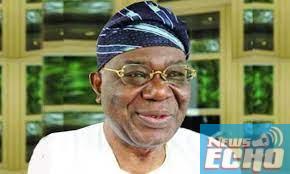
Ernest Adegunle Oladeinde Shonekan GCFR (9 May 1936 – 11 January 2022). He was the son of an Abeokuta-born civil servant and was one of six children born into the family. Shonekan attended CMS Grammar School and Igbobi College here in Nigeria before proceeding to the University of London, where he received a law degree and was called to the bar. Filled with the zeal to acquire more, he later attended Harvard Business. Ernest Adegunle Oladeinde Shonekan GCFR was a Nigerian lawyer and statesman who served as the interim Head of State of Nigeria from 26 August 1993 to 17 November 1993.
Shonekan was a British-trained Nigerian lawyer, industrialist, politician and traditional chieftain. Prior to his political career, Shonekan joined the United Africa Company of Nigeria in 1964, at the time a subsidiary of the United Africa Company played a prominent role in British colonization. He rose through the ranks in the company and was promoted as an assistant legal adviser. He later became a deputy adviser and joined the board of directors at the age of 40.
He was made chairman and managing director in 1980, and went on to cultivate a wide array of international business and political connections. He also held senior management positions in various companies and was an Oloye of the Yoruba people before he simultaneously assumed office on 2nd of January 1993, as head of transitional council and head of government under Ibrahim Babangida.
At the time, the transitional council was designed to be the final phase leading to a scheduled hand over to an elected democratic leader of the Third Nigerian Republic but his appointment was poorly received by the press and the public as he was unable to correct the dire condition of government finances which led most of the Western powers to impose economic sanctions on Nigeria.
In August 1993, Babangida resigned from office, following the annulment of the 12 June elections after signing a decree establishing the Interim National Government led by Shonekan who was subsequently sworn-in as head of state. Shonekan appointed Moshood Abiola as his vice-president and General Sani Abacha as secretary of defence who had full control over the military. Under the ING the country suffered runaway inflation and saw strikes by workers in various sectors. Most foreign investors withdrew apart from oil companies.
Shonekan made efforts to have government debt forgiven. He drew up a timetable for return to democracy and a withdrawal of Nigeria’s contingent from the ECOMOG peacekeeping force in Liberia. He also launched an audit of the Nigerian National Petroleum Corporation, the largest oil company, and tried to restore civil liberties. Shonekan managed to remove laws that allowed arbitrary arrest and confiscation of property, promoted press freedom, obtained the release of some political prisoners and made reforms to the corrupt public services and state-owned companies.
Shonekan was unable to control the political crisis which ensued following the election annulment few months into power, he also tried to schedule another presidential election and a return to democratic rule, but no clear process was given for holding fresh elections while his government was hampered by a national workers’ strike which led to a general political uncertainty under his government with the ING facing media campaigns against the delay in returning to democracy and the continued involvement of the military in politics. The government was opposed by pro-democracy activists, civil society organizations, labour unions and students.
The Lagos high court therefore nullified Shonekan’s appointment and called for Abiola to be sworn in as the elected candidate for the presidency having viewed Shonekan’s interim government as illegitimate as he released political prisoners detained by Babangida and introducing a bill to repeal three major draconian decrees of the military government.
On 17 November 1993 Shonekan’s administration was overthrown in palace coup by General Sani Abacha who forcefully dismantled the remaining democratic institutions and brought the government back under military control on 17 November 1993 and as the most senior military officer, he took over as head of state.
In 1994, he founded the Nigerian Economic Summit Group an advocacy group and think-tank for private sector-led development of the Nigerian economy. Since then Shonekan went on to feature prominently as an elder statesman. He died on Tuesday January 11th 2022 at the age of 85. At the time of his death, he was the third oldest surviving Nigerian head of state by age after Elizabeth II and Yakubu Gowon and still holds the record for the shortest serving President in Nigeria’s history