

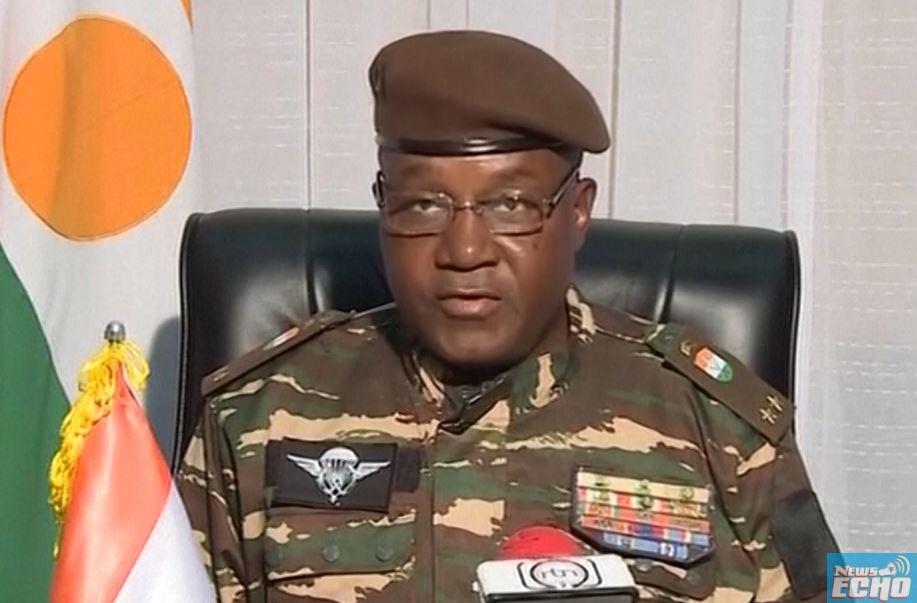

…As Niger Coup Leaders Warn against Intervention
“No more time for warning signals, it’s time for action,” said Nigeria’s President and ECOWAS Chairman Bola Tinubu during his welcome address as leaders of the 15-member Economic Community of West African States met in Abuja on Sunday to discuss the recent coup in Niger Republic which has left President Mohammmed Bazoum in detention after being overthrown by members of his presidential guard.
Tinubu said it was time to be “strong, forceful and resolute” in ensuring the re-instatement of Bazoum.
The ECOWAS leaders rose from the extraordinary meeting and issued a one-week ultimatum to the military junta holding Bazoum hostage to reinstate him as President.
“We should walk our talk,” Tinubu said just before President of ECOWAS Commission, Dr.Omar Alieu-Touray, read the communique of the close-door meeting of the West African Heads of State and Government.
Addressing the “attepted overthrow” of the constitutional order in Niger, ECOWAS reiterated its “zero-tolerance” for unconstitutional change of government in the sub-region and condemned “in the strongest terms” Bazoum’s overthrow and detention.
They insisted that Bazoum is recognised as the legitimate, elected president of Niger by the African Union and the international community.
They also rejected any purported resignation from Bazoum.
“If the authorities’ demands are not met within one week, ECOWAS will take all necessary measures, including the use of force, to restore constitutional order,” it said.
It said those responsible for violence and terror against the citizens and residents of Niger will be held accountable.
In what could be seen as a veiled reference to Russian mercenary and leader of the Wagner group, Yevgeny Prigozhin, it condemned the pronouncement of support by foreign governments and private military contractors.
Immediate actions to be taken by ECOWAS include the closure of land and air borders within ECOWAS countries and establishing an echo no-fly zone for commercial flights to and from Niger.Hide original message
There will also be a freezing of assets and suspension of all financial assistance transactions including of bodies that support the coup attempt.
ECOWAS also imposed travel bans and asset freezes for military officials involved in the coup attempt, and extended it to their family members and civilians supporting their institutions or government.
It said a representative of the ECOWAS Chair will be dispatched to Niger to deliver the demands of the authority.
Meanwhile, Military leaders in Niger have warned against any armed intervention in the country, as west African leaders meet Sunday in Abuja for an emergency summit to decide on further actions to pressure the army to restore constitutional order after a coup last week.
The heads of state of the 15-member Economic Community of West African States (ECOWAS), and the eight-member West African Economic and Monetary Union are set to meet in Nigeria, where they could suspend Niger from their institutions, cut off the country from the regional central bank and financial market, or close borders.
The west African leaders are focused on ways to restore president Mohamed Bazoum who was ousted when Gen Abdourahamane Tchiani was declared the new head of state.
Ahead of Sunday’s summit, coup leaders in Niger warned against any military intervention.
“The objective of the [ECOWAS] meeting is to approve a plan of aggression against Niger through an imminent military intervention in Niamey in collaboration with other African countries that are non-members of ECOWAS, and certain western countries,” junta spokesperson Colonel Amadou Abdramane said in a statement read out on state TV on Saturday night.
“We want to once more remind ECOWAS or any other adventurer, of our firm determination to defend our homeland,” he said.
The junta issued a second statement on Saturday night inviting citizens in the capital take to the streets from 7am local time to protest against ECOWAS and show support for the new military leaders.
The military coup in Niger has been widely condemned by its neighbours and international partners who have refused to recognise the new leaders and have demanded that Bazoum be restored to power.
Bazoum has not been heard from since early Thursday when he was confined within the presidential palace, although the European Union, France and others say they still recognise him as the legitimate president and he has been able to speak to some international leaders.
On Saturday, the European Union and France suspended financial support and cooperation on security with Niger.
Announcing the sanctions, the EU’s foreign policy head, Josep Borrell, said: “The European Union does not recognise and will not recognise the authorities from the putsch in Niger,” adding that Mohamed Bazoum “remains the only legitimate president of Niger” and calling for his immediate release.
After an emergency meeting on Friday, the African Union issued a statement demanding that the military return to their barracks and restore constitutional order within 15 days. It did not say what would happen after that.
The announcement will be a severe blow to Niger, which has been a major recipient of western aid, including from the EU and US, as an ally in the fight against jihadist insurgencies which have been destabilising the wider Sahel region.
Niger’s government has been seen by many in the international community as a bulwark against Islamist militancy in a vast arid region beset by security challenges. French and UN troops were in recent years forced to withdraw from neighbouring Mali, but France still has 1,500 soldiers in Niger. The overthrow of Bazoum could put the future of their deployment in doubt.
It also gathered that Thousands of supporters of the junta that took over Niger in a coup earlier this week marched Sunday through the streets of the capital, Niamey, waving Russian flags, chanting the name of the Russian president and forcefully denouncing former colonial power France.
The protesters marched through the city to the French Embassy, where a door was lit on fire, according to someone who was at the embassy when it happened and videos seen by The AP. Black smoke could be seen rising from across the city. The Nigerien army broke up the crowd of the protesters.
Russian mercenary group Wagner is already operating in neighboring Mali, and Russian President Vladimir Putin would like to expand his country’s influence in the region. However, it is unclear yet whether the new junta leaders will move toward Moscow or stick with Niger’s Western partners.
On Sunday at an emergency meeting in Abjua, Nigeria the West African bloc said it was suspending relations with Niger and authorized the use of force if the president was not reinstated within a week.
“In the event the authorities’ demands are not met within one week, take all measures necessary to restore constitutional order in the Republic of Niger. Such measures may include the use of force. To this effect, the chiefs of defense staff of ECOWAS are to meet immediately,” Omar Alieu Touray, president of the ECOWAS commission, said after the meeting.
Days after the coup, uncertainty is mounting about Niger’s future, with some calling out the junta’s reasons for seizing control.
President Mohamed Bazoum was democratically elected two years ago in Niger’s first peaceful transfer of power since independence from France in 1960.
The mutineers said they overthrew him because he wasn’t able to secure the nation against growing jihadi violence.
But some analysts and Nigeriens say that’s just a pretext for a takeover that is more about internal power struggles than securing the nation.
“Everybody is wondering: why this coup? That’s because no one was expecting it. We couldn’t expect a coup in Niger because there’s no social, political or security situation that would justify that the military take the power,” Prof. Amad Hassane Boubacar, who teaches at the University of Niamey, told The Associated Press.
He said Bazoum wanted to replace the head of the presidential guard, Gen. Abdourahmane Tchiani, who is now in charge of the country. Tchiani, who also goes by Omar, was loyal to Bazoum’s predecessor and that sparked the problems, Boubacar said. The AP cannot independently verify his assessment.
While Niger’s security situation is dire, it’s not as bad as neighboring Burkina Faso or Mali, which have also been battling an Islamic insurgency linked to al-Qaida and the Islamic State group. Last year, Niger was the only one of the three to see a decline in violence, according to the Armed Conflict Location & Event Data Project.
Niger had been seen as the last reliable partner for the West in efforts to battle the jihadists in Africa’s Sahel region, where Russia and Western countries have vied for influence. France has 1,500 soldiers in the country who conduct joint operations with the Nigeriens. The United States and other European countries have helped train the nation’s troops.
Regional bodies, including the West African economic bloc ECOWAS, have denounced the coup. Some taking part in Sunday’s rally warned them to stay away. “I would like also to say to the European Union, African Union and ECOWAS, please, please stay out of our business,” said Oumar Barou Moussa, who was at the demonstration.
“It’s time for us to take our lives, to work for ourselves. It’s time for us to talk about our freedom and liberty. We need to stay together, we need to work together, we need to have our true independence,” he said.
Conflict experts say out of all the countries in the region, Niger has the most at stake if it turns away from the West, given the millions of dollars of military assistance the international community has poured in. On Saturday, U.S. Secretary of State Antony Blinken said the continued security and economic arrangements that Niger has with the U.S. hinged on the release of Bazoum — who remains under house arrest — and “the immediate restoration of the democratic order in Niger.”
On Sunday, France’s President, Emmanuel Macron said attacks on France and its interests would not be tolerated. Anyone who attacked French nationals, the army, diplomats and French authorities would see an immediate response, he said.
Macron said he’d spoken to Bazoum and his predecessor as Nigerien President, Mahamadou Issoufou, hours earlier, who both condemned the coup and appealed for calm.
The attack follows France’s move on Saturday to suspend all development and financial aid for Niger.
Niger experts say it’s too soon to know how things will play out.
“Tensions with the military are still ongoing. There could be another coup after this one, or a stronger intervention from ECOWAS, potentially military force, even if it is difficult to foresee how specifically that may happen and what form that may take,” said Tatiana Smirnova, a researcher in conflict resolution and peace missions at the Centre FrancoPaix.
“Many actors are also trying to negotiate, but the outcome is unclear,” she said.