

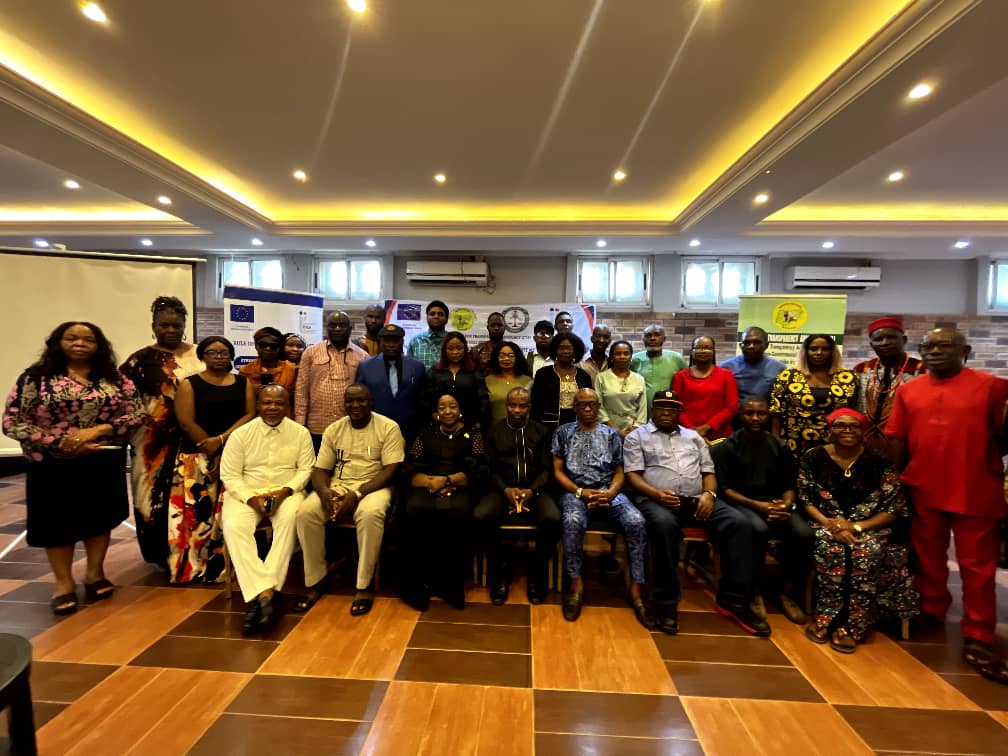
As Nigeria celebrates the Fourteen anniversary of the Freedom of Information Act, the Centre for Transparency Advocacy in collaboration with the Federal Ministry of Justice and the Anambra State ministry of Justice with support from the Rule of Law and Anti Corruption Programme (ROLAC) funded by the European Union through the International IDEA have engaged stakeholders at the Southeast Regional Roundtable on 14th years of the Freedom of Information Act in Nigeria.

The event which held stakeholders in a two day interactive session on best practices and strategies for implementation of FOI ACT was held at Finotel hotel, Agu Awka on 13th June, 2025 with the theme; “14 Years of FOI Implementation at the Sub National Level – achievements, Challenges and The Road Ahead”.
In her welcome address, Faith Nwadishi, JP, mpi, Executive Director, Centre for Transparency Advocacy (CTA) said “The round table discussion is part of a broader effort under the Strengthening Accountability and Governance in Nigeria Initiative (SAGNI)—a 12-month project we are implementing with support from the Rule of Law and Anti-Corruption Programme (RoLAC) and funding from the European Union through International IDEA. The project focused on selected federal institutions, departments in the Federal Capital Territory (FCT), Ministries, Departments and Agencies (MDAs) in Anambra and Edo States is aimed at promoting transparency, accountability, and good governance in Nigeria”.
However, “fourteen years later, we must ask ourselves, “How far have we really come?. Yes, there has been progress. But implementation remains weak. Many public institutions still operate in a culture of secrecy, while some are yet to establish the FOI unit”.
Nwadishi who frowned at a 1.2million naira demand to release information by an institution (name withheld) and commended some agencies like the Federal Inland Revenue Service (FIRS), NEITI, for responding to FOI requests promptly and maintained that that this is the kind of responsiveness we need to see across all sectors and encouraged the states to do so too”.
The CTA Boss noted that the Supreme Court ruling affirming the applicability of the FOI Act across all 36 states—regardless of whether they have passed their own FOI laws is a game-changer. “It affirms that the right to information is not conditional on geography. It is a national right—one that every Nigerian is entitled to.
At CTA, we have not just advocated—we have acted”.
Speaking on the way forward, she said “In closing the gap, we have in collaboration with the Federal Ministry of Justice and support from the Anambra and Edo State’s Ministries of Justice, under this project, held town-hall meetings across the three states mentioned, trained stakeholders from MDAs, Youth groups, CSOs, Women’s groups, community development associations, traditional institutions, media and PWDs groups. In our quest to use innovation to better implement the FOI, We held a hackathon in the FCT , Edo in Benin City on June 10 and Anambra in Awka on June 12. The FOI Act is one of our strongest tools in the fight against corruption. It is our weapon against secrecy and impunity. The citizens are the strongest force that sustains our economy, our collective existence as a nation, therefore, we must be at the forefront of this transparency effort. Let us note that; Section 1(1) of the FOI Act says:
“Notwithstanding anything contained in any other Act, the right of any person to request information is established.”
And Section 1(2) makes it even more powerful: “An applicant does not need to demonstrate any specific interest in the information.” This means you, me, and any citizen have the right—without justification—to demand answers.
Let me commend the Federal Ministry of Justice’s FOI Unit for the progress we have seen in recent times. The directive from the Head of Service to MDAs to integrate FOI units within the legal departments is a significant shift. This, combined with today’s dialogue, gives us hope”.
“Access to information is not just a legal provision—it is the heartbeat of democracy. If people don’t know, they cannot act. If they cannot act, they cannot hold power to account. And if power is not accountable, democracy suffers.
Let us not allow 14 more years to pass before we take this law seriously. Together, let’s ensure the FOI Act works—for all Nigerians as we urge all the states in the South-East region to implement the
FoI Act”.
Speaking during the keynote address, Solicitor General Anambra state, Mrs Ngozi Iluno (Mni) who spoke on behalf of the Attorney General and Commissioner for Justice, Anambra disclosed that the journey has not been easy. “Despite the progress we have made, we are still grappling with a number of challenges that hinder full implementation, especially at the sub-national level.
First “is the deeply entrenched culture of secrecy in public service. For decades, many of our institutions operated with the mindset that information was a privilege reserved for the few. That mindset does not change overnight. It takes continuous effort, policy reform, and leadership by example to create a culture where openness is the norm”.
Second, “there are practical constraints. Many MDAs lack adequate digital infrastructure for proper record-keeping and information dissemination. You cannot give what you do not have. If records are missing, outdated, or improperly stored, then even the most willing officials cannot comply with FOI requests”.
Third, “we face capacity gaps. Some officials are still unfamiliar with the FOI Act and what it demands of them. We need to integrate FOI compliance into routine public service training.
Then there is the issue of judicial enforcement. While the FOI Act provides for legal redress, litigation can be expensive and time-consuming. This deters many citizens from pursuing their rights when requests are denied”.
Providing solutions, she maintained that “we must institutionalize FOI compliance across all levels of government, embrace technology as our ally by leveraging digital platforms to facilitate proactive disclosure,
make the FOI Act part of civic education curricula so that citizens must understand not only their rights but also how to assert them and Civil society organizations must continue to act as watchdogs, advocates, and educators and lastly, the judiciary to prioritize FOI cases and issue sanctions for wrongful denials. When legal remedies are swift and decisive, they serve as a deterrent to non-compliance.
In her call to action, Mrs Iluno emphasized that fourteen years is enough time to reflect, but also enough time to renew. “We must recommit ourselves to making transparency not just a buzzword but a way of life. Let us push for state-level FOI laws where they do not yet exist. Let us mainstream FOI compliance in budget and procurement processes. Let us reward openness and penalize secrecy”.
“To my fellow public servants: the FOI Act is not our enemy. It is our shield. It protects us from the erosion of trust. It forces us to do our jobs better. It gives us the opportunity to serve with integrity.
To our partners in civil society and the media: keep asking the tough questions. Keep demanding answers. You are the conscience of our democracy.
And to the citizens of Nigeria: know that your voice matters. Your right to know is protected by law, Use it, Demand it, Own it. The FOI Act ensures that the information which fuels such a press and indeed an informed citizenry, is available. Let us make it work. Let us strengthen it. Let us defend it”.
In Addition, the National Coordinator, Pay What You Publish Nigeria, Dr Erisa Danladi said ‘Publish What You Pay Nigeria’ is an international coalition existing in 54 countries. “It’s a campaign to ensure that the natural resources God have given us are utilised and the outcome used to benefit the people. It’s a campaign of transparency, accountability around natural resources where government manage them for the good of the people”.
She noted that Publish Pay Nigeria has a commitment to the FOI in the case that every common man can ask questions about governance.” We are a partner in it because this is what will empower the citizen to be able to know, interact and hold office holders accountable. We have been collaborating with the minstry of justice or any relevant agencies to ensure we do what we are supposed to do.
Collaborating, Prof Godwin Onu, member of Southeast, Publish What You Pay Nigeria said the group have been running an advocacy role by driving home all that is contained in the FOI to make sure it gets to the grassroots. “We have done that by teaching students the aim of FOI as well as using social media handles to propagate this information to the people”.
Moreover, Mr Ignatuis Obiora who represented the Chairman, National Orientation Agency, Anambra state, Mr Edozie Ajiegbo expressed satisfaction for partnering with CTA as regards to FOI Act. “The awareness and the campaigning for the implementation of the FOI is a welcome development. We found out that the issue of accountability and transparency is very critical in Nigeria and the leaders hold the citizens’ duty to be accountable to them and that is why freedom of Information is important in any democratic setting to deepen democratic participation. The citizens should be able to be carried along in all the government policies and activities and that is why this programme is pertinent. NOA have been propagating the need for the FOI Act because we are saddled with the responsibility of value orientations, mobilisation and sensitisation. So in line with this initiative, we will continue to partner with CTA”.
Highlights of the event were the interactive session by stakeholders on achievements of FOI, it’s implementation and the way forward. While dignitaries present were, Mr Sunny Oti and Amaka Ogu from the Actors Guild of Nigeria, Dr Emeka Onunamadu- Founder Southeast Democracy Clinic, Programme/Communication Manager of the Centre for Transparency Advocacy (CTA), Mr McDonald Ekemezie, Distinguished members of the Rule of Law and Anti-Corruption (RoLAC) Programme,
Representatives of the European Union and International IDEA, Traditional and Religious Leaders, Civil Society Leaders, and the Media.

