


By James Kalu
Elections in Africa have long been plagued by corruption and a lack of adherence to established guidelines.
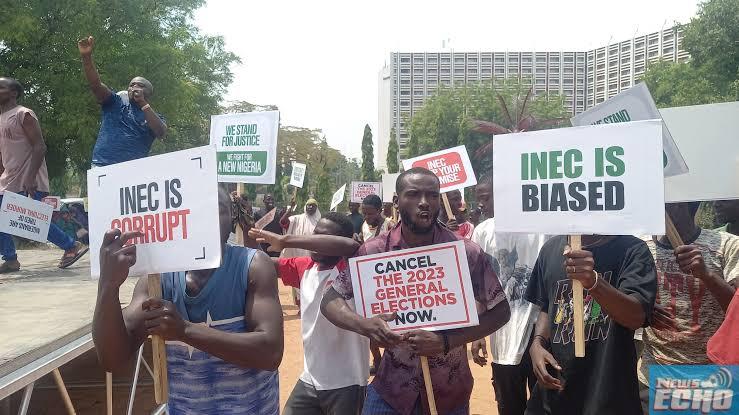
The Nigeria 2023 general election serves as a prime example of how elections in the region often start and finish on the same day due to the corrupt manner in which they are conducted.
This report not only highlights the failure of the Independent National Electoral Commission (INEC) to obey its own guidelines but also sheds light on the compromised judicial system, which allows winners to confidently challenge their opponents to go to court, knowing that the system can be manipulated. The 2023 general election in Nigeria was anticipated as an opportunity for progress and democratic consolidation.
However, the election process was marred by widespread corruption and manipulation, which undermined its credibility. Alongside the corrupt conduct of the election, the judiciary’s biased judgments further eroded confidence in the electoral process.
Throughout the Nigeria 2023 general election, corruption and manipulation were pervasive, starting from the initial stages and continuing until the final results were declared. These practices included voter intimidation, ballot box stuffing, vote-buying, and falsification of results.
These activities were carried out by various actors, including political parties, candidates, and even some electoral officials. INEC, as the body responsible for organising and supervising elections in Nigeria, plays a vital role in ensuring free, fair, and transparent electoral processes.
However, during the 2023 general election, INEC failed to uphold its own guidelines, further contributing to the corrupt manner in which the election was conducted. INEC’s mismanagement of electoral materials, such as the delayed distribution of ballot papers and result sheets, created chaos and confusion at polling units.
This provided an environment conducive to electoral malpractices, as unscrupulous individuals took advantage of the situation to manipulate the process.
Compromised Judicial System and Biased Judgments:
The judicial system in Nigeria, as in many African countries, has faced allegations of bias and manipulation. The confidence with which winners of the Nigeria 2023 general election boldly challenged their opponents to go to court reflects the belief that the judicial system can easily be influenced to favour certain interests.
Judgement on the appeal file by the candidates of the PDP, Labour Party, and APM delivered on October 26, 2023, by the Supreme Court of Nigeria was widely perceived as biased and lacking in impartiality. This further eroded public trust in the judiciary and reinforced the notion that the judicial system can be manipulated to serve the interests of the ruling party or influential individuals.
The Nigeria 2023 general election exemplifies the corrupt manner in which elections are often conducted in Africa. The failure of INEC to adhere to its own guidelines, along with a compromised judicial system, has severely undermined public confidence in the electoral process.
To restore trust and credibility, it is crucial for African countries to prioritise electoral reforms, strengthen institutions responsible for organising elections, and ensure an independent and impartial judiciary. Only through these measures can Africa move towards a future where elections are conducted fairly and transparently and where the judicial system upholds the principles of justice and equality.
=============================================================

