

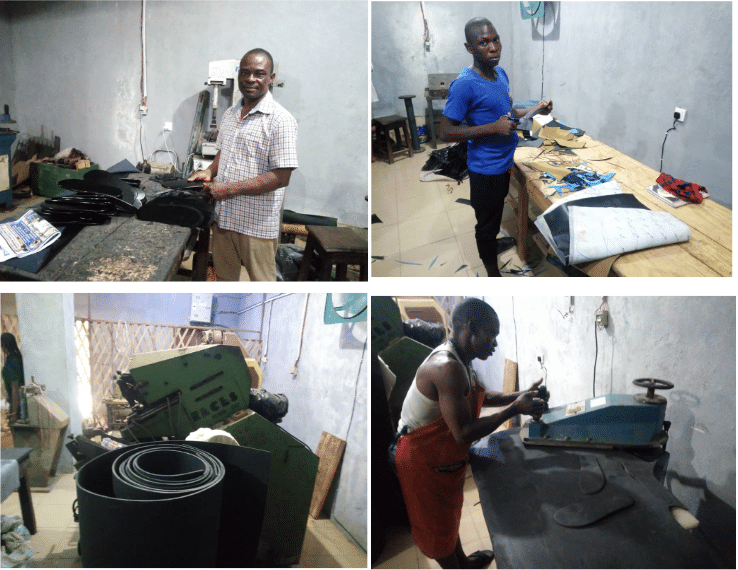
When you visit the Ariaria Shoe Cluster, you will never talk down on the ability of the Igbo man.

The creativity, the zeal, dedication and the desire to make their products competitive is written on everybody’s eyes.
For many years, the Aba shoe-makers have been operating and running their businesses in an informal system.
Most of the shoe-makers make their products; write foreign brand names just to gain acceptability in the wider market.

Nowadays, the system is changing. Made in Aba products are beginning to enter into African markets with brand names of properly registered Nigerian shoe manufacturing companies.
Ken Anyanwu, Managing Director of Nikan and Felly Nigeria Limited, a shoe making company registered with the cooperation affairs commission said he has entered a fresh line of business since the registration of his company.
“We’ll regard ourselves as start-ups because it’s right now that our company is regarded and recognized as an entity. Having been registered sometime September last year (2020) and acquired some equipment we’ve entered an entirely new line,” he said.
Anyanwu said that the formal sector and the informal sector are two big different line of production that can only be understood by someone who knows the enormous benefits in the formal sector.
“I just made a step outside the informal sector, but I’ve discovered the gap is much. When the Export Development Fund (EDF) was announced, those who are registered and incorporated applied.
“You only need to meet some demands. Get Nigeria Export Promotion Council (NEPC) export certificate, get your tax clearance so that’s a huge difference. The informal sector doesn’t have the muscles and prerequisite to go after such things.”
Explaining how the new move will help the improvement in shoe making and marketability of the products, Anyanwu said the formalization of his company and other companies has changed their system of production.
“I knew what it took me to formalize my business. For the last 40 years, we’ve been exporting from here to Cameroun directly, no registration, no data to capture what we’re doing.
“We only assume, but don’t really have enough data to back up what we’re moving out in the informal sector. The comparison between both sectors is much. The gap is too wide.
“The informal sector can’t meet with certain conditions necessary for real business. They can’t even record their exports. We’ve not really began exporting, but we’re formally registered now.
“I cannot write any other name or country outside here on my products. It must bear my company’s name and trademark. If I fail to do that, I’m running my own business.
“Why did I spend time and money to formalize my business and can’t do the necessary thing needed? I can’t shortchange myself. I’ll have to develop different titles for my brand. Get names.
“Wherever you see our products, it must be clear that it’s ours and standardized. We have the machines and we’ve moved away from informal production. It’s time to promote our brand.”
Speaking on brand quality, market/customer base and government’s help on export related issues, Anyanwu said there is now room for improvement after formalization of his business.
He described the Export Development Fund (EDF) is an opportunity the government really want to use to help the organized industrialists and companies are export driven.
“One thing about our business is that both local and International Markets, we’re there. When I was doing the summary of my application, I told them, look, Nigeria’s population is estimated to be 200 million, which means, we have 200 million foots to take care of.
“That’s to say that these 200 million foots, translate to 200 million pair of shoes. Assuming people buys two pairs that translate to 400 million pairs. For instance in West Africa, Nigeria is almost three quarter of West Africa.
“Invariable, if you produce for Nigeria, you’re producing for West Africa and the majority of Central African countries. East African countries and Southern African Countries depend on Nigeria for shoes.
“So, when you’re making arrangements for local production, you’re also making arrangements for exports because the two works together. So, over one million pairs of shoes leave here every week.
“So, invariably, if you produce what Nigerians will buy, somebody who can buy our shoes in Aba, goes to Lagos and export to Congo DR, Zimbabwe, South Africa, Tanzania or whatever is exporting.”
He stressed that EDF will always enhance their production capacity as it will enable them to get necessary equipment that will help improve their production qualities and capacities.
“I applied for a Toe Lasting Machine, currently, I have a Toe Lasting Machine that my engineers are working on it to function properly. However, that’s a mono-functional machine.
“So, I saw a multi-functional machine that can do the toe, the back and the side of a shoe. That’s a three-in-one machine. That’s why I went for it. So, I believe the committee will understand our plights.
“There are issues that have to do with why we’re not exporting enough. We don’t have the capacity because we don’t have the right equipment.
“When we talk about right equipment, we’re talking about having a lasting machine that will give you a shoe that’s competitive and can match what you have in America, China and Europe.
“That machine I’m going for is what should do the job right here. Here is my factory and also a resource centre for other shoemakers that’ll come here to finish their products. Once we have it on ground, it’ll serve my company and the cluster.”
Challenges facing shoe manufacturers in Aba:
Anyanwu said that the effect of Covid-19 on shoe manufacturing in Aba is too heavy and is threatening to take most of the shoe-makers off business.
He said, “You know that business post Covid-19 is going through a lot. A lot of things changed. The way people were traveling before Covid-19 is no longer the same.
“Prices of many things went high. In advance economies, there are some policies that cushioned the effect of Covid-19 pandemic.
“I’ll commend FG for the N30,000 palliative per individual. I got mine, although I didn’t get to everyone, but it is just a drop of water in the economy and politicians hijacked it.
“Most of us spent a lot of morning during the Covid-19 lockdown and everything is now looking as though we’re starting afresh. People are still struggling as many children are now out of school.
“The economy is in a bad shape. The present insecurity in our country has made it impossible for people to move around for business.
“From time to time you hear of curfew, attacks and all what you may have it called. In all these, those of us in the Small and Medium Scale Businesses (SMEs) are the first to get the shock of these problems.
“SMEs are the worst hit. We only get money when we sell. You can’t even borrow money from your neighbour let alone the bank. Post Covid-19 business has been very hectic.
“We can’t say we’ve picked-up because as there are still some basic machines that I need which is why I had to go to EDF. We want to start producing the little one we can produce so that people can be buying.
“We’re making arrangements that anytime from next week, I’ll start rolling out some palms so that they can test the market and see how it is. God has been faithful to us.
“All along, we’ve been planning, how do we move in, how do we make sure that we really establish our foot into the industry?
“We’ve tried it in the informal sector, now that we’re in the formal sector; we believe that sooner or later, everything will be better.”
Anyanwu added that he runs his business with a 40KVA power generator with the cost of a litre of diesel at N255, which according to him is causing him more lost than profit.
He added that the he and other manufacturers are always hopeful that the much talked about commencement of power distribution by Geometric Power (A private power station in Aba, that is capable of offering constant electricity) will come sooner than later.
“I don’t make it using this method at all. There’s no way one can survive in business using this method at all. We’re not meeting up not to talk of making profit.
“The coming of geometric power will bring an upsurge to our business. We’re expecting it. One of our major challenges here is power. If Geometric starts today and come to the aid of Aba leather cluster, everything will change.
“I just spent N8000 buying diesel that will not last for more than 4 hours. If I have light all through the day, work will be done fully.”
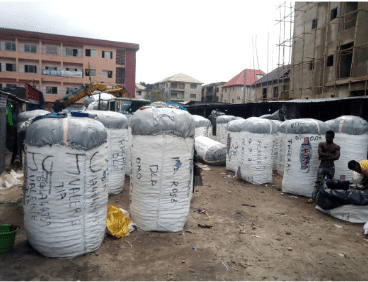
Mr. Nicodemus Ebere Orji, Manager of the Cameroon Park, Aba where most of the shoes produced are packaged and moved for onwards distribution all over Africa said they need government’s help.
According to him, “My job is to do the logistics. We move millions of shoes away from here regularly. We want government to help us in the area of machines for loading. See the Hiab Loader Crane, trucks, we need more of such.”
He said that many agencies have been coming there for inspection, but none has offered to help them and improve the crude style of loading that is making things hard for them.
“My job here is to transfer goods to different parts of Africa. Malabo, Cameroon, Chad, Gabon, Congo and different parts of Africa. All the goods here come from the shoe makers here in Ariaria.
“When other African brothers and sisters come here to buy, after buying their goods they come here, I package and transfer their goods to their various destinations.
“If any government agency can come here for information to help us, I’ll give them every necessary information,” he said.

