

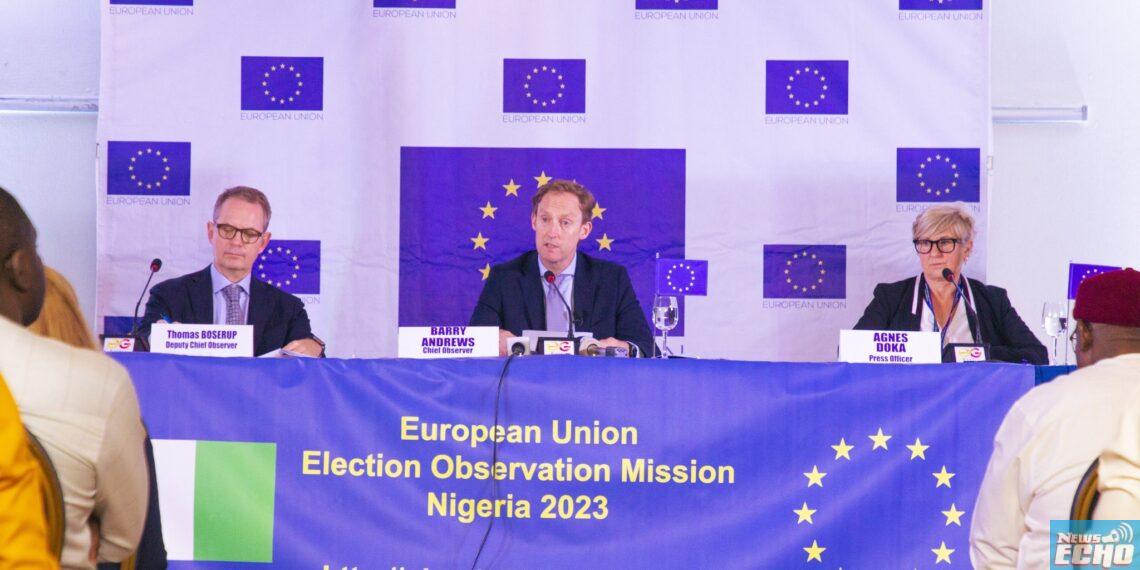
The European Union Election Observation Mission (EUEOM) on Tuesday presented its final report on the last Nigerian general elections highlighting six priority areas.
The Chief Observer of the mission, Barry Andrews, presented the report which has 25 recommendations, at a press conference in Abuja.

Nigeria’s electoral body, the Independent National Electoral Commission (INEC), conducted the presidential and National Assembly elections on 25 February while the governorship and state houses of assembly polls were held on 18 March.
Supplementary elections were conducted in some constituencies across the country on 15 April.
The EU Election Observers Mission (EOM) carried out its work between January 11 and April 11, at the invitation of Nigeria’s Independent National Electoral Commission (INEC).
A delegation of the European Parliament joined the EU EOM for the observation of the presidential and National Assembly elections.
The mission accredited a total of 110 observers from 25 EU Member States, as well as Norway, Switzerland, and Canada.
Presenting the report, Mr. Andrews said: “we are particularly concerned about the need for reform in six areas which we have identified as priority recommendations, and we believe, if implemented, could contribute to improvements for the conduct of elections.”
The areas, he said include removing ambiguities in the law; establishing a publicly accountable selection process for INEC members, and ensuring real-time publication of and access to election results.
Others are providing greater protection for media practitioners, addressing discrimination against women in political life, and addressing impunity regarding electoral offences.
Although the last elections showed the commitment of Nigerians to democracy, it also exposed enduring systemic weaknesses and therefore signal a need for further legal and operational reforms to enhance transparency, inclusiveness, and accountability, Mr Andrews noted.
He added that shortcomings in law and electoral administration hindered the conduct of well-run and inclusive elections and damaged trust in INEC.
He stated that political will is crucial in achieving improved democratic practices in Nigeria and the EU stands ready to support Nigeria in the implementation of its recommendations.
The Mission also made some recommendations that included the following:-
Removing ambiguities in the law:
Protect the interests of voters through certainty of law for all stages and aspects of electoral processes by eliminating from electoral law and regulations errors and ambiguities to avoid potential for conflicting interpretations, and ensuring the revision processes are inclusive.
Establishing a publicly accountable selection process for INEC members:
Establish a robust operational framework for the independence, integrity, and efficiency of electoral administration through an inclusive and publicly accountable mechanism for selecting candidates to the posts of INEC commissioners and RECs based on clear criteria of evaluation of merits, qualifications, and verified non-partisanship.
Ensuring real-time publication of and access to election results:
Protect the free expression of the will of the voter and integrity of elections by establishing a robust, transparent, and easily verifiable results processing system with clear rules. These include uploading polling unit results from the polling unit only and in real time, at each level of collation results forms to be uploaded in real time, and all forms to be published in an easily trackable and scrapable database format.
Providing greater protection for media practitioners:
Afford adequate protection to freedom of expression by developing a comprehensive operational framework underpinned by the skills and means for ensuring prompt investigation and prosecution of all types of attacks against media practitioners.
Addressing discrimination against women in political life: Undertake urgent and robust affirmative action to ensure meaningful women’s representation through special measures in line with the Beijing principles and the National Gender Policy to increase the representation of women as candidates and in elected office, further supported by cross-sectoral, intensified, and sustained capacity building and sensitization to eliminate discrimination.
Addressing impunity regarding electoral offences: Address impunity for electoral offences through robust, well-defined, and effective inter-agency coordination governed by clear rules on non-partisanship, optimization of resources, delivery of effective investigation and sanctioning, and provision of regular public consolidated information on outcomes.
The presidential election, perhaps the most competitive in recent history, saw Bola Tinubu of the ruling All Progressives Congress (APC), emerge winner. He was sworn in as president on 29 May.
The election is being contested in court by the two other candidates: Peter Obi of the Labour Party (LP) and Atiku Abubakar of the Peoples Democratic Party (PDP).
Similarly, the exercise is being challenged by some candidates at the subnational level.
However, INEC National Commissioner for Information and Voter Education, Festus Okoye spoke in response to the European Union (EU) election observation mission’s final report on the recently concluded general election.
Reacting to the report, Okoye said it is unfair to judge the commission and the entirety of the polls off a few glitches.
He noted that in other reports submitted, domestic and international observers attested to the fact that in terms of voter accreditation, the BVAS performed optimally.
The national commissioner, however, noted that certain factors contributed to issues encountered in the conduct of the elections.
“If you look at those challenges, you must also look at the context of the elections, also the environment which was surrounded by, one, insecurity in so many parts of the country. Nobody can dispute that,” he said.
“Secondly, there were also issues targeted at some of our staff and other Nigerians.
“You have to also look at the issues of fuel scarcity during that particular period and the issue of the naira redesign and also that we had significant challenges with transporters.
“So these are some of the issues we’re going to look at.”
Okoye said INEC would act on the recommendations made by the EU mission.
“One of the lessons that we must learn is that we must have faith in our democratic institutions. Is it every time that we have a challenge with a particular section of the constitution that we now run to the national assembly to amend the law? There has to be some level of fidelity, that is the only way we can progress,” he said.
“The other issue I want to outline is that democracy is not a 100m dash, we as a people and a nation have to build our democratic institutions and our own democracy.
“You heard the chief observer say that there is democratic regression in so many countries of the world, are we supposed to also regress? No. We have to be positive and build our own.
“Those who say there is nothing positive about our democracy are saying that we should allow anti-democratic forces to take over and nobody does that.”
In as much as the Mission recommended for improvements in future elections as solutions, we urge the Election Petition Tribunals take note of the awful indictments on the Independent National Electoral Commission (INEC).

