

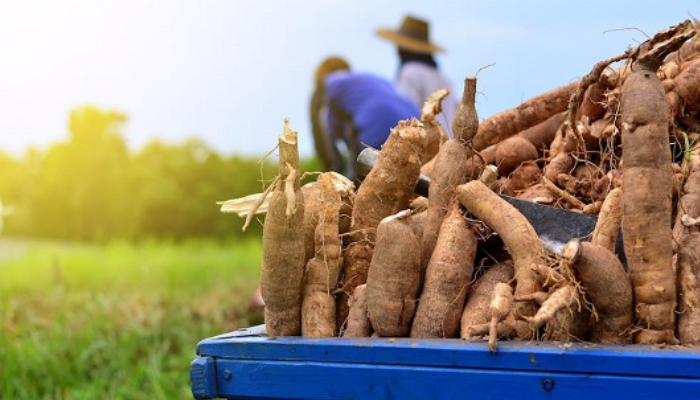
The Federal Government has embarked on the training and empowerment of smallholder farmers on cassava value chain production in Abia State particularly women and youths of Omoba in Isiala Federal Constituency at National Soil Laboratory, FMARD, Umuahia,
This is part of its efforts to ensure that the yield gap in cassava is addressed through dissemination and adoption of improved technologies as well as innovation by smallholder farmers.

The cassava farmers who were exposed to how best to grow a good cassava crop which included: good site selection; proper land preparation; choosing desirable/improved varieties, were also trained on healthy cassava stems selection, high yielding resistant varieties among other best practices.
Speaking during the training at National Soil Laboratory, FMARD, Umuahia, the Abia State Director, Federal Ministry of Agriculture and Rural Development, FMARD Mr. Victor Ihediwa said that the federal government was diligently working towards achieving food and nutrition security through its various activities .
Ihediwa said one of the ways in which the his office was working to achieve this objective was through the promotion of various crops such as cassava in which Nigeria has comparative advantage in production.
“This is coupled with encouraging youth and gender empowerment activities that will not only increase productivity and income but also offer more economic opportunities to farmers in the cassava value chain”, Ihediwa added.
He expressed optimism that the training would facilitate the creation of sustainable cassava production system, provide increased yield productivity, ensure good agronomic practices, and empowerment of youth and women in production.
The resource persons who included: Mr. Yakubu Ibrahim from FMARD and Agric Extension Officer, Mr. Daniel Ikechukwu Ndukwe exposed the farmers on how best to handle hardwood cassava stems to prevent bruises and damage to the nodes and to improve sprouting.
Other aspects of planting to improve cassava production touched by the resource persons were the selection of the correct planting time; method of planting cassava cuttings; correct plant spacing; early weeds control; herbicide use in root and tuber crops; how to improve the physical and chemical properties of the soil; better land utilization, reduction of soil erosion and risk of crop loss by inter-cropping cassava with either maize or legumes.

